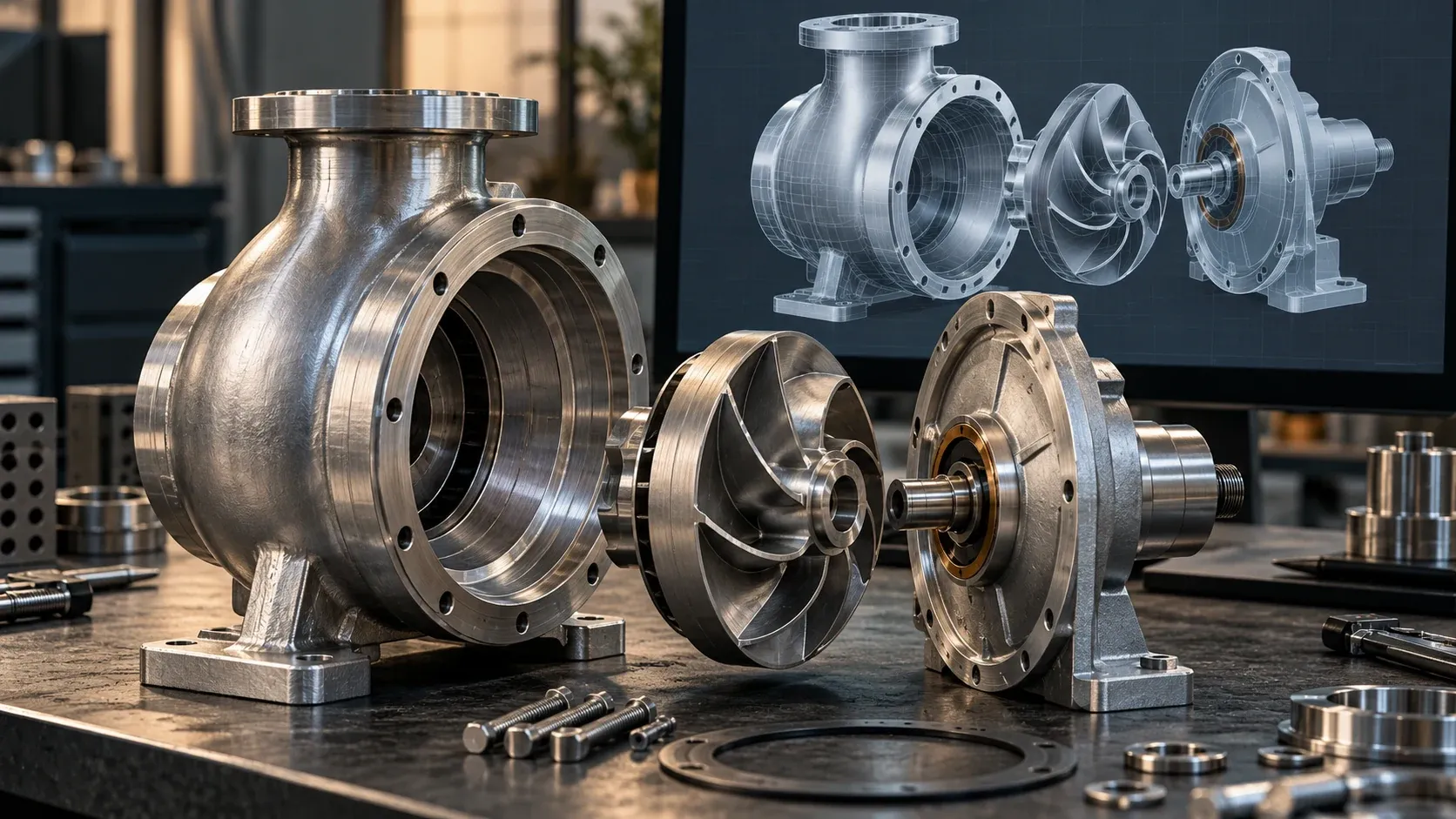
Your company’s CAD archive may be worth assessing for an AI data partnership if your organization can authorize the proposed use and explain what the files contain. Start with one well-understood collection: its native models, available exports, design revisions and supporting documentation.
A folder of files alone does not establish permission or suitability. A useful first assessment connects the engineering content to the people who can approve a discussion. It should also explain the archive’s limits before anyone prepares an export.
This guide is for manufacturers, product developers and engineering firms that hold CAD data. It explains how to scope an archive, distinguish different kinds of technical content and prepare a high-level licensing enquiry. It is general information, not legal or engineering advice.
Why CAD data is relevant to AI development
CAD records can describe geometry, relationships between components and the steps an engineer used to build or change a design. Those are different learning problems. A project that studies editable modeling operations may need information that a collection of rendered images cannot provide.
In 2026, Autodesk Research described neural CAD as a class of models designed to work directly with the geometric representations used in professional design and to preserve design intent and constraints. In a separate CAD editing benchmark, professional designers wrote edit requests for existing 3D models, and a second group of designers carried out the same requests to give a human baseline for judging AI edits.
These projects show why the context around a design can matter. They do not establish that a named lab is offering to buy your archive. A potential partnership still needs a defined use, an appropriate collection and agreement on the rights involved.
What might be inside a company CAD archive?
Describe the archive in engineering terms before calling it a dataset. Several collections may sit in the same storage system:
| Archive component | What to establish internally |
|---|---|
| Native part models | Authoring software, versions, editable content and missing references |
| Assemblies | Component relationships, referenced parts and configuration coverage |
| Sketches and feature history | Which modeling operations and constraints are retained and readable |
| Revisions | How versions connect and whether the sequence is complete |
| Neutral exports | Available representations and how they relate to native models |
| Engineering drawings | Drawing-to-model links, revision alignment and approval status |
| Design documentation | Requirements, change requests, explanations and review records |
| Supporting results | Whether a design connects to tests, manufacturing observations or simulations |
This is a scoping worksheet, not a list of required deliverables. An archive does not need every item to be described accurately. The first task is to identify what exists and what would require additional preparation.
Keep simulation records as a separate collection when their meaning depends on solver settings, meshes and boundary conditions. The CFD simulation data guide explains that review in more detail.
Establish who can approve a licensing discussion
Identify the organization and role responsible for deciding whether a proposed use can be considered. That may involve engineering leadership, a commercial owner, information security and legal review. The route depends on how the designs were created and the agreements governing them.
For each candidate collection, record whether it includes internal product designs, customer projects, supplier components or work created by contractors. Locate the relevant agreements rather than assuming one rule applies to the entire archive.
Ask your internal reviewers:
- Which organization controls this collection and can authorize its assessment?
- Do customer, supplier or contractor agreements restrict reuse?
- Does the archive include third-party components or reference material?
- Which information must remain confidential, and who decides any exclusions?
- Which countries, recipients and intended uses need review?
A software subscription, a login or responsibility for maintaining a vault does not answer these questions. Technical access and authority to grant a new use are separate matters.
WIPO’s trade-secret overview notes that trade secrets can cover technical information such as designs and drawings, and that protection varies between countries and legal systems. Treat that as background for your review, not clearance for a particular transfer. A confidentiality agreement also does not, by itself, establish that the signatory can license every file. Our data licensing principles explain how DataNexx approaches provenance and licensing rights.
Count engineering objects separately from files
A file count can hide substantial duplication. One design might appear as a native model, several neutral exports, a drawing, thumbnails and multiple backups. An assembly can also reference components stored elsewhere.
Use separate counts, where reasonably available, for:
- Unique parts or design families.
- Assemblies and configurations.
- Revisions or modeling histories.
- Export files and their relationship to source models.
- Drawings and supporting documents.
Explain the counting rule. If a count is an estimate, label it as an estimate and state what was included. Avoid presenting every export or revision as a separate independent design.
Do not remove versions simply to make a collection look cleaner. A revision may contain useful information about how a design changed. Keep the original relationships internally and distinguish revisions from accidental duplicates.
Document the archive’s technical boundaries
Choose a coherent subset before proposing the whole vault. A product family, a defined historical period or one engineering workflow is often easier to understand than a collection spanning unrelated tools and projects.
Record the authoring applications and versions, the available formats, and the dependencies needed to interpret the files. State whether models open successfully in the environment your team uses. Note missing references, obsolete formats, broken assemblies and incomplete histories.
Keep the language precise. “Native CAD available” does not tell a reviewer whether an archive includes editable feature history, only imported geometry, or a mixture. Likewise, an export should not be described as equivalent to the source without checking what it preserves.
A high-level overview can identify these distinctions without exposing a design. Detailed technical inspection and any later delivery should follow an agreed process.
Use a company CAD archive assessment worksheet
Complete this internally before sending a first enquiry. Use “unknown” where the evidence is missing.
| Assessment field | What to write down |
|---|---|
| Collection boundary | Product family, business unit, time period and exclusions |
| Internal decision owner | Role that can approve assessment and later use |
| Creation context | Internal, customer, supplier or contractor work |
| Technical coverage | Parts, assemblies, drawings, histories and available documentation |
| Software coverage | Applications, versions and known migration issues |
| Counting method | Unique designs, revisions, configurations and export copies |
| Linkage | How models, drawings, changes and supporting records connect |
| Known limitations | Missing dependencies, damaged files and incomplete documentation |
| Review requirements | Agreements, confidentiality, personal information and local requirements |
| Preparation effort | Work required to describe, check and package the chosen subset |
The worksheet is an inventory of evidence and unresolved questions. Completing it does not make the collection available for licensing.
Hypothetical example: a manufacturer has native models and neutral exports for an older product line. Some components were designed internally; others came from suppliers. The engineering team can describe the internally created subset first and route the supplier material for separate review. It does not need to treat the mixed folder as one indivisible offer.
This example illustrates scoping only. It is not a DataNexx customer story, inventory claim or prediction of demand.
Questions to resolve in a proposed CAD data licence
If a project progresses, the agreement needs to describe the permitted use and the collection it covers. Useful questions for the appropriate reviewers include:
- Is the purpose evaluation, model training, another development activity or a defined combination?
- Which files, versions, documentation and exclusions are in scope?
- Who may access the material, and may any rights be passed to another party?
- How will confidentiality, security, retention and later updates be handled?
- What treatment of derived material and model outputs needs to be agreed?
These questions help define the conversation; they are not a model contract. A licensing arrangement and an outright transfer of rights can have different consequences. Establish the actual terms instead of relying on the label “data partnership.”
Commercial interest also depends on a particular project’s needs. There is no standard price implied by a file type, company size or number of years in business. Avoid spending heavily on conversion or annotation before the intended scope is understood.
Prepare a first enquiry without uploading designs
A first message can be short. Describe the industry, the countries involved, the general engineering domain, software families and approximate time coverage. Explain which kinds of material exist and what remains under review.
For a collection of drawings, use the engineering drawing archive guide to describe revision and model links. For a broader introduction to the process, read how companies license data to AI developers.
You can use this structure:
We are a company in [industry and country]. We hold a CAD archive covering [general engineering domain and period]. It includes [broad asset types] in [software families or formats]. Our internal assessment is led by [role]. Known limitations include [high-level gaps]. We would like to discuss whether a defined subset could support an AI data partnership.
Replace the brackets with a high-level description. Leave out customer names, proprietary geometry, credentials, confidential project details and the files themselves.
Describe your CAD archive to DataNexx. Start with what your organization holds and who can assess the proposed use. Any later technical review, preparation or sharing should follow the scope and approvals established for that project.
Frequently asked questions
Can engineering firms license customer CAD files?
They should first establish what the relevant agreements permit and who can authorize the proposed use. Creating or storing a design does not, by itself, settle the rights to reuse it for AI development.
Do we need to convert our CAD archive before making an enquiry?
No. Describe the formats, software versions and dependencies you already have. A specific project can then determine whether conversion is useful and what information must be preserved.
Are native CAD files always more useful than STEP or STL exports?
There is no universal preference. Different representations retain different information, and suitability depends on the task. Describe the available content rather than assuming an extension establishes its value.
Should we send sample CAD files with our first enquiry?
No. A first enquiry only needs a high-level description: industry, country, engineering domain, formats, time coverage and known gaps. Any sample would come later, with an agreed purpose, recipients and internal approval.
Does a large CAD archive guarantee a licensing deal?
No. A potential project depends on its intended task, archive coverage, documentation, permissions and commercial terms. A clear description helps assess fit; it is not a promise of a transaction.
Sources
Official and primary sources, checked on the date this guide was last updated.
Prepared by DataNexx with AI-assisted research and writing. Sources are linked throughout. This is general information, not legal advice.