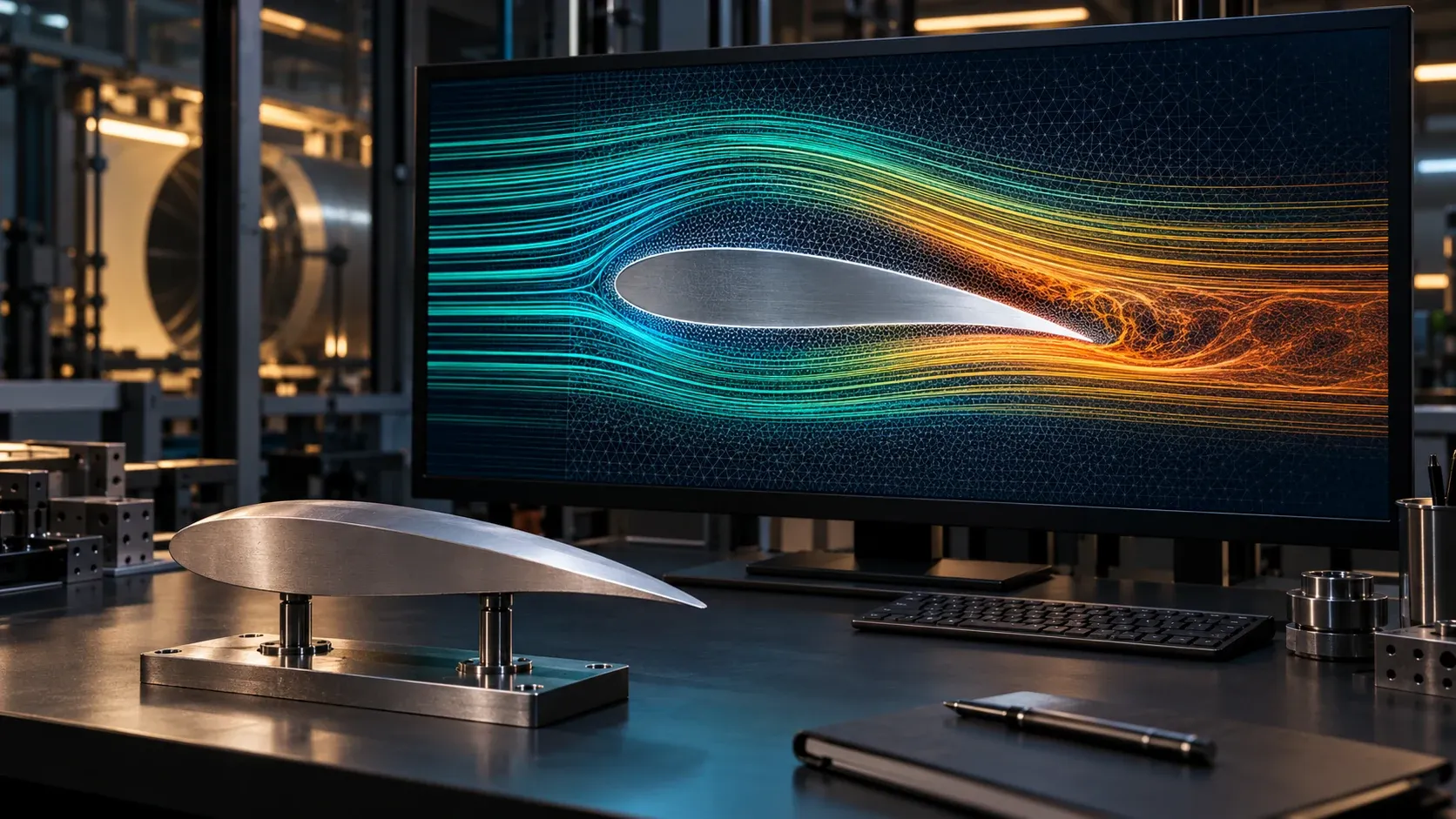
A CFD archive is easier to assess for data licensing when each result can be traced to its geometry, mesh, physical assumptions, boundary conditions and solver setup. Start with the record of how a case was run and what its outputs mean.
A directory of pressure fields or a presentation of flow images rarely answers those questions on its own. The supporting context determines whether another technical team can interpret the collection and understand its limits.
This guide is for simulation consultancies, manufacturers and R&D teams considering whether an internally controlled computational fluid dynamics archive could support an AI data partnership. It provides a case manifest and a preparation checklist. It is not a CFD certification procedure or a prediction that a particular lab will buy the data.
Why CFD data is relevant to engineering AI
AI models can be trained to approximate relationships between engineering inputs and simulation outputs. To assess such a collection, a reviewer needs to know which geometries, operating conditions and numerical approaches it represents.
In a 2026 post on its research, PhysicsX described building its own simulation pipeline to create a proprietary automotive aerodynamics dataset: more than 20,000 CFD simulations across over 250 baseline vehicle designs. Using it alongside public datasets, the company reported that current models still generalize poorly to new geometries and to different CFD setups.
That is evidence that documented diversity in simulation data matters technically. PhysicsX generated its own collection; the post does not establish an open offer to buy outside archives, and its scale is not a threshold for suppliers. Describe your actual cases and avoid presenting accumulated compute hours as proof of commercial demand.
Define a case before stating a dataset size
Several counts can describe the same archive:
- Distinct geometries or design families.
- Physical operating conditions.
- Mesh versions.
- Solver runs and restarts.
- Saved time steps or field snapshots.
- Derived quantities, plots and reports.
Explain what your count means. One transient run with many saved time steps is different from many independent physical cases. A rerun using a refined mesh is different from a new geometry.
For an internal manifest, use a case identifier that connects the design, operating condition and numerical setup. Keep links to reruns and derivative outputs. The identifier can be an internal reference; a first enquiry does not need to expose proprietary filenames or project names.
When combining historical projects, state where the grouping rules change. Do not describe unrelated external-flow, internal-flow and thermal-flow studies as one uniform collection merely because they share a file extension.
Describe the physical problem and its coverage
Group cases by the problem they represent. Record the engineering domain, relevant flow regime and the assumptions used in the analysis. Depending on the collection, useful fields may include the fluid model, temperature treatment, compressibility assumptions, turbulence approach, moving boundaries and whether the calculation is steady or transient.
State the covered ranges only where your records support them. Separate conditions that were simulated from conditions inferred or extrapolated later.
A reviewer should be able to distinguish a broad design study from a dense set of variations around one baseline. Both can be described accurately, but they are different collections. Keep design-family relationships available so later reviewers can assess how much of the archive is closely related.
The purpose is to explain coverage, not to meet a universal minimum number of cases. None is proposed here.
Link geometry, mesh and solver configuration
For each case, establish which geometry version was used and what transformations occurred before meshing. Note changes such as simplified components, symmetry assumptions or removal of small features where those are documented.
Then connect that record to the mesh and solver configuration. Useful information can include mesh generation method, refinement approach, wall treatment, solver and version, numerical schemes, model settings and case-specific configuration files.
Retain the distinction between the intended setup and the setup actually executed. A configuration template does not prove every historical run used the same settings. If the executed configuration is missing, mark that gap instead of reconstructing it from memory and presenting it as fact.
The CFD analysis process in the long-standing NASA and NPARC Alliance tutorial runs from formulating the flow problem and modeling the geometry, through boundary conditions, grid generation and simulation, to comparing results and documenting the work. It is useful background for organizing the record, not a licensing specification or a mandatory project standard.
Explain boundary conditions and output conventions
Document enough context for another engineering team to understand the variables. Depending on the case, that may include inlet and outlet conditions, wall conditions, reference quantities, fluid properties and the coordinate system.
For outputs, record:
| Output detail | What needs to be clear |
|---|---|
| Variable meaning | The physical quantity and any derived definition |
| Units | Dimensional units or the stated nondimensional convention |
| Reference values | Quantities used to define coefficients or reference states |
| Location | Whether values are associated with cells, nodes, surfaces or probes |
| Time meaning | Instantaneous values, time averages, sampling intervals and averaging windows |
| Pressure convention | The reference used, where relevant, rather than an unexplained pressure label |
| Geometry association | How fields and surface quantities connect to the correct case |
| Derived processing | Interpolation, filtering, aggregation or other post-processing |
This table is a preparation aid, not a required schema. Tailor it to what the archive contains.
Avoid giving a variable the same label across projects when its definition changed. If historical conventions differ, preserve the original definitions and document any later normalization.
Keep convergence, verification and validation distinct
A completed run is not automatically evidence that its results are suitable for an intended use. Preserve the checks that were performed and the questions they address.
The same tutorial’s verification and validation overview separates the two ideas. Verification asks whether the computational implementation is correct, for example by comparison with exact analytical results. Validation asks whether the simulation agrees with physical reality, through comparison with experimental results. Its grid-convergence page explains how successive grid refinements can be used to estimate discretization error.
For an archive assessment, record separately:
- Run completion and solver status.
- Iterative behavior and monitored quantities.
- Available grid or time-step sensitivity studies.
- Comparisons with analytical references or other verification evidence.
- Comparisons with experimental measurements and their conditions.
A residual history should not be described as experimental validation. Likewise, a comparison with another solver is not automatically a measurement of agreement with the physical system.
State what was checked, by whom or by which process where recorded, and what evidence remains available. If validation was outside the original project scope, say that rather than applying the label retrospectively. This guide does not propose a numerical convergence threshold; acceptance criteria belong to the specific project.
Use a CFD case manifest worksheet
Build a small, internally reviewed manifest before discussing a large export. The following fields can help establish whether the archive is interpretable:
| Manifest field | Record or question |
|---|---|
| Case identity | Stable case ID and links to reruns or related cases |
| Design family | Which geometries share a common baseline or parent design? |
| Geometry version | Exact source version and documented preprocessing |
| Physical setup | Flow regime, modeled physics and key assumptions |
| Operating conditions | Boundary conditions, fluid properties and reference quantities |
| Mesh | Mesh identity, generation approach and available refinement information |
| Solver | Application, version and relevant configuration |
| Run status | Completed, interrupted, diverged or another recorded state |
| Convergence evidence | Residual histories, monitored quantities and stopping rules where available |
| Verification evidence | Available checks of numerical implementation or discretization behavior |
| Validation evidence | Experimental reference, matching conditions and limitations, if available |
| Outputs | Variables, units, field locations, time coverage and format |
| Post-processing | Transformations between solver output and delivered quantities |
| Authority and exclusions | Internal decision owner and material requiring separate review |
Use “unknown” or “not recorded” when appropriate. Do not infer a successful run status solely from the presence of an output file.
A manifest helps identify preparation work. It does not establish ownership, technical certification or permission to distribute the cases.
Record unsuccessful runs without treating them as physical truth
Interrupted, divergent or otherwise unsuccessful runs may be present in a historical archive. Keep their status explicit. Depending on the intended task, a reviewer may want to understand numerical failures, workflow decisions or the conditions leading to a rerun.
That does not make an unsuccessful result a reliable label for the physical system. Separate a solver failure from a design failure, and distinguish both from a case that was never executed.
Hypothetical example: an engineering team has several mesh refinements for the same geometry. One run was stopped early and another reached its recorded stopping criteria. They should remain linked but carry different statuses. Counting their field files together without that context would conceal the distinction.
This example is fictional and does not describe an available DataNexx dataset.
Establish authority and the proposed use
Identify the organization and role that can approve assessment of the collection. Review the context in which the work was commissioned and any applicable customer, supplier, confidentiality or software-related terms with the appropriate internal specialists.
A consultancy may hold the simulation files while a customer controls important rights in the design or project material. Access to the compute cluster or the ability to export a result does not settle permission for a new use.
If a potential project develops, clarify whether the scope covers evaluation, training, another use or a defined combination. Agree the files and documentation involved, the recipients, access arrangements, exclusions and any ongoing preparation or update duties.
The CAD data licensing guide covers the approval questions in more detail. If the cases connect to technical drawings, maintain those links using the engineering drawing inventory.
Start with a high-level description of one case family
Describe your organization type, country, engineering domain and the broad case families available. Include solver families, approximate time coverage, the kinds of outputs retained and the main documentation gaps.
Exact project names, geometries, solver files and customer information are not needed in the first enquiry. Neither is a speculative bulk conversion. An agreed technical review can later establish which representations and documentation are useful, under the handling described on our data security page.
Describe your CFD simulation archive to DataNexx. Explain what the cases represent, which supporting records exist and who can assess the proposed use. Keep raw files and confidential project details out of the initial submission.
Frequently asked questions
Can a company license CFD simulation data for AI training?
A company can explore a defined project if it can establish authority for the proposed use and describe the collection accurately. Suitability and permission depend on the actual cases, agreements, countries and intended use; the existence of a CFD archive does not guarantee a deal.
Are pressure and velocity fields enough for a first assessment?
A first enquiry can describe the available fields at a high level. A later technical review may need geometry, mesh, operating conditions, solver settings, units and other context to interpret them. Requirements depend on the project.
Does a converged run mean the simulation is validated?
No. Iterative convergence, numerical verification and comparison with experimental reality address different questions. Describe the checks actually performed and the supporting evidence rather than using one label for all three.
Do we need experimental validation data before an enquiry?
No. Describe the checks that exist, including where none were performed. Validation evidence can add useful context, but an archive should not be labeled validated unless comparisons with measurements were actually made and recorded.
Should we remove failed CFD runs?
Do not silently mix or delete records to make the archive look uniform. Preserve original records internally, mark their statuses and discuss whether unsuccessful runs are relevant to the intended task. A numerical failure should not be presented as a valid physical result.
Sources
Official and primary sources, checked on the date this guide was last updated.
Prepared by DataNexx with AI-assisted research and writing. Sources are linked throughout. This is general information, not legal advice.